
Vehicle recovery dubai is not one job done the same way every time. A family SUV, a 4×4 stuck in the sand, a low luxury car, and a motorcycle all need different equipment, different loading, and different care — and sending the wrong truck can waste time or damage the vehicle. This guide explains how recovery changes with the vehicle you drive, what the recovery team will ask you, and what happens when the truck arrives, so you know what to expect whatever you are driving in Dubai.
Recovery Dubai provides recovery across Dubai, 24/7, for cars, SUVs, 4x4s, luxury cars, motorcycles, vans and pickups. When you call +971 50 668 1183, tell the dispatcher what vehicle you have, where it is, and what happened to it, and the exact price is confirmed with you on the call before any truck is dispatched. Our car recovery page explains the full process, from the call to the drop-off.
Why One Truck Does Not Fit Every Vehicle
Every vehicle is different in the ways that matter to a recovery driver: how heavy it is, how high or low it sits, whether all four wheels drive it, and how much it is worth. A flatbed that suits a small hatchback may not suit a long luxury car with a low front end, and a wheel-lift that works for a light car is not the right choice for a heavy 4×4 with a broken axle. The dispatcher asks about your vehicle for a reason — the answer decides which truck is sent, what equipment goes on it, and how the vehicle will be loaded and secured.
The other thing that changes with the vehicle is what can go wrong while it is being moved. A car that still rolls and steers is loaded very differently from one whose wheels will not turn, and a vehicle with four-wheel drive cannot be towed with two wheels on the road in the way a front-wheel-drive car can. That is why the first questions on the call are always about the vehicle itself: what it is, whether it starts, whether it rolls, and whether it steers. The answers shape everything that follows.
Vehicle Recovery Dubai for SUVs and Family Cars
SUVs are the most common recovery job in Dubai, and in most cases the job is straightforward — but an SUV is heavier and taller than a small car, and that changes the loading. A mid-size SUV usually goes onto a flatbed, where all four wheels are off the road and the vehicle is strapped down for the journey. The bed tilts down, the SUV is driven or winched up onto it, and the driver checks every securing point before setting off. Because the vehicle is higher, the driver also checks the clearance on the bed and the space around it, especially in a tight car park or a narrow residential street.
Family cars — the everyday saloons and hatchbacks that carry children to school and their owners to work — are usually the simplest to recover. If the car still rolls and steers, it can be driven or winched onto the flatbed in a few minutes. If it will not start, the problem is often a flat battery, and a jump start may be enough to get it going again without a full recovery. If a tyre has gone flat, a tyre change on the spot may be possible where it is safe to do it. The driver will judge this when he sees the car and the place it is in.
What matters most with an SUV or a family car is the destination. Tell the dispatcher whether the car needs to go to a garage, to your home, or to a dealership, and confirm the price on the call before any truck is dispatched. If you are not sure which garage to use, say so — the dispatcher can talk through the options with you. If the situation changes while you wait, call back and say so straight away, so the price and the destination can be confirmed again before the work starts.
4x4s and Off-Road Vehicles
A 4×4 is built for rough ground, but that does not make it easy to recover — in some ways it makes the job harder. A 4×4 is heavy, it sits high, and its four-wheel-drive system means it cannot be towed with two wheels on the road. The only safe way to move a 4×4 that cannot be driven is on a flatbed, with all four wheels off the ground. A wheel-lift tow that drags the rear wheels along the road can damage the drivetrain, so a recovery driver will not use it for a 4×4.
Many 4×4 recoveries in Dubai happen away from the road altogether — a vehicle stuck in soft sand on the edge of the city, or bogged down after leaving the tarmac. That is a different job from a breakdown on Sheikh Zayed Road, and it needs different equipment: a winch. Our winch-out recovery page explains how a stuck vehicle is pulled free, but the short version is this: the winch cable is attached to a strong point on the vehicle, the truck anchors itself, and the vehicle is pulled slowly and steadily back onto firm ground. It is slow work, and it has to be — a fast pull can damage the vehicle or the winch.
If your 4×4 is stuck in sand, do not keep trying to drive it out. Spinning the wheels only digs the vehicle deeper and can damage the tyres and the drivetrain. Switch the engine off, call for help, and share your location pin — a 4×4 stuck in the sand is often far from a road or a landmark, and the pin is the most reliable way for the driver to find you. Tell the dispatcher that the vehicle is off-road and stuck, not just broken down, so the right truck and the winch are sent the first time.
Luxury Cars and Sports Cars
Luxury cars and sports cars need the most careful handling of any vehicle on the road, and the reason is simple: they are low, they are valuable, and many of them have four-wheel drive or complex suspension that does not forgive a careless tow. A low front end can catch on a steep loading ramp, a lowered car can scrape where a normal car clears easily, and an all-wheel-drive sports car must travel with all four wheels off the road. For all of these reasons, a luxury or sports car is recovered on a flatbed — never with two wheels on the ground.
Loading a low car takes more time than loading a normal one, and it should. The driver will check the ground clearance before the car moves, use the shallowest loading angle the bed allows, and watch the front end as the car comes up the ramp. If the car is too low for a normal flatbed approach, the driver may use boards or a different loading position to reduce the angle. This is not a delay — it is the care that keeps the car’s bodywork, splitter and underbody undamaged. If you drive a lowered car, tell the dispatcher when you call, so the driver arrives knowing what to expect.
Once the car is on the bed, it is secured at four points, with straps or chains that hold it without marking the wheels or the bodywork. The driver checks every securing point before setting off, and the car does not move on the bed at all during the journey. When the car arrives at the garage or the dealership, it is unloaded the same way — slowly, with the same care at the front end. If your car has just been in an accident, tell the dispatcher that too, and read our accident towing page for what happens next.
Motorcycles and Bikes
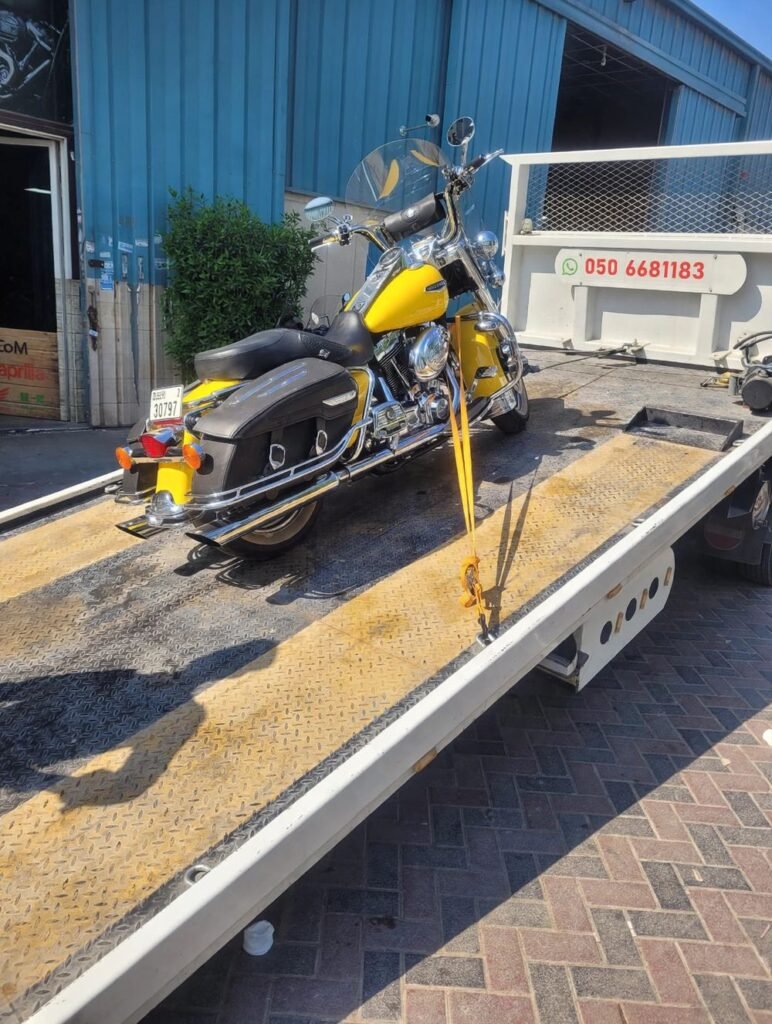
Motorcycles are recovered very differently from cars, and they need equipment a car flatbed alone does not provide. A bike has two wheels and no handbrake to hold it still, so it must be held upright and strapped down from the moment it is loaded. Our motorcycle towing page covers this in full, but the key points are these: the bike is rolled or pushed up a ramp onto the flatbed, held upright in a wheel chock or by the driver, and then secured with soft straps at the handlebars and the frame — never with a chain around the paintwork or the forks.
Bikes come in many shapes in Dubai — a commuter bike, a sports bike, a cruiser, a heavy touring bike — and the loading changes with the bike. A heavy cruiser needs a wider ramp and more hands than a light commuter bike, and a sports bike with low fairings needs the same care at the front as a low sports car. Tell the dispatcher what kind of bike you have and whether it still rolls, so the right ramp and straps are on the truck. If the bike has fallen over, say so as well — the driver will check it before loading, and will not force a wheel that does not turn.
The same care applies to a bike that will not start. A flat battery on a motorcycle is often a jump start away from running again, and the driver will judge whether that is safe to try where the bike is. If the bike needs to go to a garage, it travels upright and strapped on the flatbed, exactly as it was loaded. The destination is confirmed on the call, as it is for a car, and the exact price is confirmed before any truck is dispatched.
Vans, Pickups and Work Vehicles
Vans and pickups are the workhorses of Dubai’s roads — delivery vans, trade pickups, and vehicles carrying tools, stock or equipment — and their recovery has one extra question that a car does not: what is inside the vehicle. A van full of stock is heavier than an empty one, and a pickup carrying a load needs to be secured so the load does not shift during the journey. Tell the dispatcher what the vehicle is carrying, and whether the load can stay in the vehicle or needs to be moved first.
A loaded van or pickup usually goes onto a flatbed, like a heavy SUV. The driver checks the weight and the length before loading, and secures the vehicle at four points. If the vehicle is too long or too heavy for a standard flatbed, the dispatcher will say so on the call and send the right truck — which is why the questions about the vehicle matter. If the vehicle has broken down with a load that cannot wait — chilled goods, for example — say so when you call, so the dispatcher knows the job is time-sensitive.
For a business, a broken-down van is not just a vehicle problem, it is a working day interrupted. If the van needs to go to a garage, confirm the destination and the price on the call, and ask the dispatcher what time the truck will arrive. If the load needs to be transferred to another vehicle, say so — the recovery team can talk through what is possible where the van is, and what needs a second vehicle.
What to Tell the Dispatcher — Whatever You Drive
The call is the same whatever the vehicle, and it is short if you have the details ready. Tell the dispatcher: what the vehicle is — make, model and type, especially if it is a 4×4, a luxury car, a lowered car, or a motorcycle; where it is, with a shared location pin on WhatsApp if you can; what happened — whether it will not start, will not roll, will not steer, is stuck, or has been in an accident; and where it needs to go — a garage, your home, or a dealership. Then confirm the price on the call before any truck is dispatched.
Two details people often forget are worth adding. First, whether the vehicle is automatic, and whether it has four-wheel drive — both change how the vehicle can be moved. Second, whether anyone is with you, and whether you are on a highway, in a car park, or off-road. A vehicle on a live lane of Sheikh Zayed Road is a different job from the same vehicle in a mall car park, and the dispatcher needs to know which one it is.
If you are not sure about something — whether the car is a 4×4, whether the wheels will turn, whether the bike’s wheel is bent — say so. The dispatcher would rather hear “I am not sure” than a wrong answer that sends the wrong truck. The driver will check the vehicle when he arrives and will confirm the plan with you before anything is loaded.
What Happens When the Truck Arrives
When the recovery truck arrives, the driver will check the vehicle before touching it — whether it starts, whether it rolls, whether it steers, and whether anything is leaking or damaged. This check decides how the vehicle is loaded: driven onto the bed, winched onto it, or lifted with the winch where the wheels will not turn. The driver will confirm the destination and the price agreed on the call, and will explain what he is doing as he goes, so you know what is happening to your vehicle.
Loading is the same in principle for every vehicle, and different in detail for each one. On a flatbed, the bed tilts down and the vehicle is driven or winched up onto it, then secured at four points with straps or chains so it cannot move during the journey. A motorcycle is held upright and strapped at the handlebars and the frame. A 4×4 stuck in sand is winched free before it is loaded. A low luxury car is loaded at the shallowest angle the bed allows. In every case, the driver checks every securing point before setting off, and will not rush that step.
When the vehicle arrives at the destination, it is unloaded the same way — slowly, with the same care. You can ride with the driver or meet the truck at the destination, whichever was agreed on the call. Before the driver leaves, check the vehicle with him — that it is where you wanted it, and that nothing has changed during the journey. If anything looks wrong, say so there and then, while the driver is still with you.
What Vehicle Recovery Costs — And What Decides It
There is no single fixed price for vehicle recovery in Dubai, and any figure quoted without knowing your vehicle and your situation would be a guess. What decides the price is the distance, your vehicle type and weight, the kind of truck and equipment needed, and the situation — a 4×4 winched out of sand needs different equipment from a family car that will not start in a car park, and a low luxury car needs more loading time than a hatchback. That is why the exact price is always confirmed with you on the call before any truck is dispatched: you know what you are paying before anyone sets off, and the figure agreed on the call is the figure that applies.
If a quote sounds unusually cheap, ask what it actually covers before you agree to it — a price that leaves out the distance, the truck type, or the destination is not a complete price. And if the situation changes after the call — the destination changes, or the vehicle turns out to need a different truck — say so as soon as you know, so the price can be confirmed again before the work starts. The full pricing guide is in our post on what car recovery costs in Dubai.
Whatever you drive — a family SUV, a 4×4, a luxury car, a motorcycle, a van or a pickup — the first step is the same: a call, a location pin, and a price confirmed before the truck sets off. Recovery Dubai works across Dubai, 24/7, with the right truck for the vehicle you have, not just the nearest one.
Frequently Asked Questions
What is vehicle recovery in Dubai?
Vehicle recovery in Dubai is the service that collects a vehicle that cannot be driven — because it will not start, has broken down, has been in an accident, or is stuck — and carries it on a flatbed recovery truck to a garage, your home, or a dealership. Recovery Dubai provides it across Dubai, 24/7. Call +971 50 668 1183, share your location pin, and the exact price is confirmed with you on the call before any truck is dispatched.
Can a 4×4 be towed with two wheels on the road?
No — a 4×4 must travel with all four wheels off the road, on a flatbed. Towing a 4×4 with two wheels on the road can damage its four-wheel-drive system. Tell the dispatcher that your vehicle is a 4×4 when you call, so a flatbed is sent the first time.
How is a luxury or sports car recovered safely?
On a flatbed, with all four wheels off the road, loaded at the shallowest angle the bed allows so a low front end does not catch on the ramp. The car is secured at four points with straps that do not mark the wheels or the bodywork. If your car is lowered, tell the dispatcher when you call, so the driver arrives knowing what to expect.
How are motorcycles recovered in Dubai?
A motorcycle is rolled or pushed up a ramp onto the flatbed, held upright in a wheel chock, and secured with soft straps at the handlebars and the frame — never with a chain around the paintwork or the forks. Tell the dispatcher what kind of bike you have and whether it still rolls, so the right ramp and straps are on the truck.
What should I tell the dispatcher about my vehicle?
What it is — make, model and type, especially if it is a 4×4, a luxury car, a lowered car, or a motorcycle; whether it starts, rolls and steers; where it is, with a location pin; what happened; and where it needs to go. Also say whether it is automatic and whether it has four-wheel drive — both change how the vehicle can be moved.
What does vehicle recovery cost in Dubai?
It depends on the distance, your vehicle type and weight, the kind of truck and equipment needed, and the situation — there is no single fixed price. The exact price is always confirmed with you on the call before any truck is dispatched, so you know what you are paying before anyone sets off.
Our Recovery Services in Dubai
Need Your Vehicle Recovered in Dubai? Call Now
Tell us what you drive and where you are — we will confirm the price on the call and send the right truck for your vehicle, anywhere in Dubai, 24/7.
Call +971 50 668 1183 WhatsApp Us
24/7 across Dubai — or reach us through our contact page.