
Dubai recovery service help on a highway is different from help on a quiet street. On Sheikh Zayed Road, Emirates Road, or Al Khail Road, traffic moves fast, there is nowhere safe to stand beside your car, and a small problem can become dangerous in minutes. This guide explains what to do first when your car breaks down on a Dubai highway, how a recovery service reaches you there, and what happens from the call to the drop-off — so you stay safe while help is on the way.
Recovery Dubai provides recovery across Dubai, 24/7, including the highways. When you call +971 50 668 1183, tell the dispatcher which highway you are on, which direction you are travelling, and the nearest exit, interchange, or landmark — the exact price is confirmed with you on the call before any truck is dispatched. A location pin shared on WhatsApp is the fastest way to be found on a highway, where street names and building numbers do not help. Our car recovery page explains the full recovery process in detail.
First: Get Safe — Before You Think About the Car
On a highway, your safety comes before the car, the call, and everything else. If your car can still move, steer onto the hard shoulder or the nearest safe stopping area and stop as far from moving traffic as you can. Switch on your hazard lights straight away, so drivers behind you can see that you have stopped. If your car has stopped in a live lane and cannot be moved, stay inside it with your seatbelt on and your hazard lights on — getting out into fast-moving traffic is more dangerous than staying in the car.
Once the car is stopped, get yourself and everyone with you to the safe side of the barrier — the side away from the traffic — and stay there. Do not stand between your car and moving traffic, do not stand in front of or behind the car where it cannot be seen, and do not try to check under the bonnet while traffic is passing close by. On Sheikh Zayed Road, the hard shoulder is narrow in places and traffic passes at speed; the barrier is there for a reason, and you should be behind it.
If it is dark, your hazard lights and the lights of your car are what other drivers see first. Keep them on. If you have a reflective vest or a warning triangle in the car and you can reach them without stepping into traffic, use them — but only if it is safe to do so. Never walk along a live highway to look for help, an exit, or a petrol station. Help comes to you; you do not go looking for it on foot.
What to Tell the Dispatcher on a Highway Call
A highway call needs different details from a call in a residential area, because the dispatcher cannot find you by a building name. The most useful things you can give are: the name of the highway — Sheikh Zayed Road, Emirates Road, Al Khail Road, or another — the direction you are travelling in, and the nearest exit number, interchange, or well-known landmark. A shopping mall, a metro station, or a major interchange is far more useful than a street name on a highway.
Share your live location pin on WhatsApp if you can. On a highway, a pin is the fastest and most reliable way to be found, and it avoids the back-and-forth of describing where you are. Also tell the dispatcher what your car is doing — it will not start, it overheated, a tyre burst, the steering feels wrong — and what kind of car it is, especially if it is automatic, four-wheel-drive, lowered, a sports car, or a motorcycle. That decides which truck is sent, and sending the right truck first time matters most on a highway, where a second trip means more waiting beside fast traffic.
Finally, tell the dispatcher where the car needs to go — a garage, your home, or a dealership — and confirm the price on the call before any truck is dispatched. If you are not sure which garage to use, say so; the dispatcher can talk through the options with you. The price is agreed on the call, so there should be no new figure when the truck arrives.
Sheikh Zayed Road: What Makes It Different
Sheikh Zayed Road is Dubai’s busiest highway, and it is where most highway breakdowns in the city happen. It runs through the heart of the city, past the Marina, JLT, Business Bay, and Downtown, with exits coming thick and fast — which helps, because the dispatcher can usually place you by the nearest interchange. But it is also the road where traffic is fastest and the hard shoulder is most exposed, so the safety rules above matter most here.
A common Sheikh Zayed Road breakdown is a car that overheats in slow, stop-start traffic, or a car whose battery gives up after the air conditioning has been working hard in the heat. Another is a tyre problem at speed. In all of these, the first job is the same: hazards on, car to the hard shoulder if it can move, everyone behind the barrier. Do not try to change a tyre on the hard shoulder of Sheikh Zayed Road yourself — the traffic passing beside you is too close and too fast. Wait for the recovery team, who will either fix it safely or load the car and take it somewhere safe.
If your car has stopped on Sheikh Zayed Road after an accident, the same safety rules apply, and you should also take photos of the scene if it is safe to do so from behind the barrier. Our accident towing page explains what happens after a collision, including the photos and paperwork that help at the scene.
Emirates Road and Al Khail Road: Longer Stretches, Fewer Exits
Emirates Road (E311) and Al Khail Road (E44) are different from Sheikh Zayed Road in one important way: the distances between exits are longer, and there are fewer landmarks to describe. A breakdown here can leave you with open road on both sides and nothing obvious to name. That is why a shared location pin matters even more on these roads — it tells the dispatcher exactly where you are, without you having to describe a stretch of road that looks the same for kilometres in either direction.
On Emirates Road, many breakdowns happen on the long runs between interchanges, where a car that has been running at highway speed for a long time overheats or develops a fault far from the nearest exit. If that happens to you, the same rule applies: hazards on, hard shoulder if the car can move, everyone behind the barrier, and then the call. Do not drive on with a warning light or a strange noise in the hope of reaching the next exit — a car that fails completely in a live lane is far harder to help than one that has already stopped safely on the hard shoulder.
Al Khail Road connects the older and newer parts of the city and carries heavy traffic at peak times, with interchanges at Business Bay, Al Quoz, and beyond. A breakdown here often means stopping where traffic is merging or leaving the road, so getting clear of the slip roads and onto a safe stopping area matters. Tell the dispatcher which interchange you are near and which direction you were travelling in, and share a pin — the combination of the two is usually enough to place you exactly.
How the Recovery Truck Reaches You on a Highway
When the dispatcher sends a truck to a highway breakdown, the driver is given your pin, your direction of travel, and the nearest exit or landmark. The truck approaches from the same direction you are travelling in, so it can pull in behind you on the hard shoulder rather than crossing lanes to reach you. That is another reason the direction of travel matters: a truck coming the wrong way cannot reach you safely.
When the truck arrives, the driver will check the car before touching it — whether it will start, whether it will roll, whether it can steer — and will confirm the destination and the price agreed on the call. On a highway, this check happens quickly and with safety first: the driver will work from the safe side of the car where possible, and will not ask you to stand in traffic. If your car can still be driven a short distance to a safer stopping area, the driver may suggest that; if it cannot, the car is loaded where it stands.
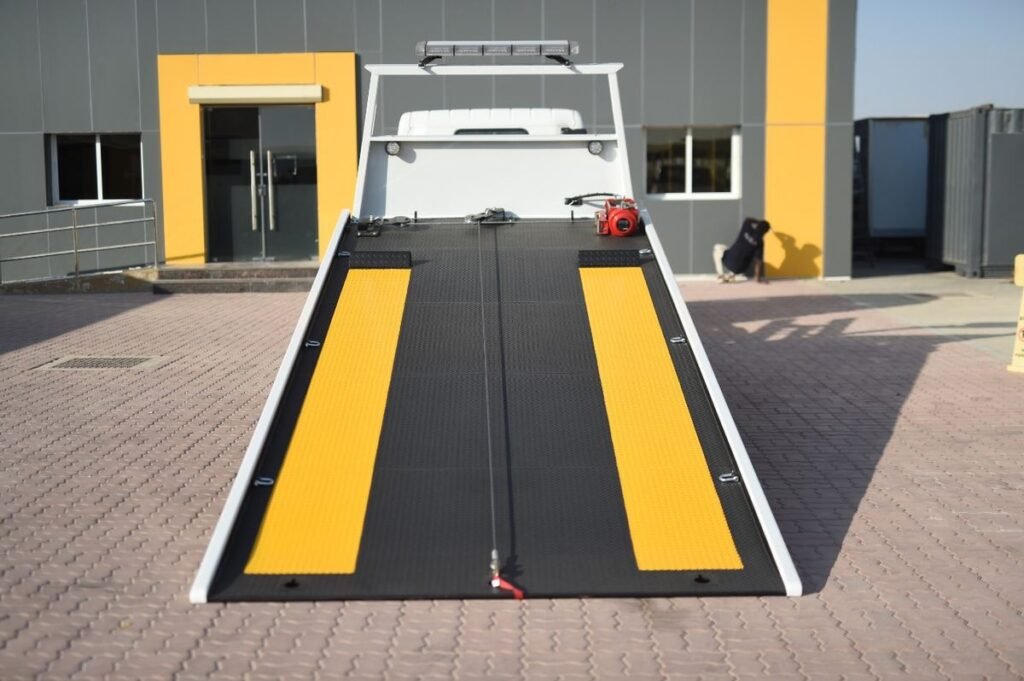
Loading on a highway is the same as loading anywhere else — on a flatbed, the bed tilts down and the car is driven or winched up onto it, then secured with straps or chains so it cannot move during the journey. The difference is the setting: everything is done with the traffic in mind, and the driver will not rush the securing step. A properly secured car does not move on the bed at all, and the driver checks every securing point before setting off.
What If Your Car Cannot Be Moved From a Live Lane?
Sometimes a car fails in a live lane and cannot be moved to the hard shoulder — the steering has locked, the wheels will not turn, or the car has stopped where there is no shoulder at all. If that happens, stay inside the car with your seatbelt on and your hazard lights on, and call for help from inside the car. Do not get out into a live lane to push the car or to wave traffic down.
Tell the dispatcher clearly that the car is in a live lane and cannot be moved. That changes how the truck is sent and how the driver approaches — the recovery team will need to reach you with extra care, and may need to work with the traffic around you. Give your exact direction of travel, the nearest exit or landmark, and a shared pin, and stay on the phone if the dispatcher asks you to. The most important thing you can do in this situation is stay put, stay visible, and stay in touch.
Highway Breakdowns at Night
A breakdown on a highway at night is harder in two ways: you are more difficult to see, and it is harder for you to see where it is safe to go. Your hazard lights and your car’s lights are your first protection — keep them on, and do not switch the car off if its lights are the only thing marking your position. If you can, get everyone behind the barrier, and keep your phone charged so the dispatcher and the driver can reach you.
At night, describing where you are is also harder, because landmarks are less visible. A shared location pin is the most reliable way to be found, and the dispatcher will use it to guide the truck to you. Tell the dispatcher it is dark and you are on a highway, so the driver knows to look for your hazard lights. Our next post in this series covers night breakdowns in full — what to do while you wait in the dark, and how to stay safe until the truck arrives.
What a Highway Recovery Costs — And What Decides It
There is no single fixed price for highway recovery in Dubai, and any figure quoted without knowing your situation would be a guess. What decides the price is the distance, your vehicle type, the kind of truck needed, the time of day, and the situation — a car stuck in a live lane or damaged in an accident needs different equipment from a car that simply will not start on the hard shoulder. That is why the exact price is always confirmed with you on the call before any truck is dispatched: you know what you are paying before anyone sets off, and the figure agreed on the call is the figure that applies.
If a quote sounds unusually cheap, ask what it actually covers before you agree to it — a price that leaves out the distance, the truck type, or the destination is not a complete price. And if the situation changes after the call — the destination changes, or the car turns out to need a different truck — say so as soon as you know, so the price can be confirmed again before the work starts. The full pricing guide is in our post on what car recovery costs in Dubai.
After the Drop-Off: What to Check
When the truck reaches the destination, the driver will unload your car in a safe, flat place — a garage forecourt, a driveway, or a parking area, wherever was agreed. The car is unloaded the same way it was loaded, slowly and carefully, and the driver will check the car’s condition with you before leaving. Walk around the car with them. Check the wheels, the bumpers, and any damage you photographed before the tow. If anything looks different from your photos, say so there and then, while the driver is still with you — not after they have gone.
Once the car is off the truck, confirm where the keys are going. If the car is going to a garage, the keys usually stay with the garage; if it is going to your home, they come back to you. Make sure the garage knows the car has arrived, especially if you are not there yourself. And if the car still needs work, the next step is the garage’s, not the recovery truck’s — recovery moves your car safely to where it can be repaired, and the repair itself happens at the workshop.
A Short Highway Checklist to Keep in Your Car
Before your next drive on Sheikh Zayed Road, Emirates Road, or Al Khail Road, it is worth having these things ready: your phone, charged, with the recovery number saved — +971 50 668 1183; a way to share your location on WhatsApp; and the name of your garage or the place you would want the car taken to, so you do not have to decide it under stress. Check that your hazard lights work, and keep a reflective vest or warning triangle in the car if you have one. None of this needs much room, and all of it makes a highway breakdown shorter, safer, and easier to deal with.
The most important thing to remember is simple: on a highway, safety first, car second. Hazards on, everyone behind the barrier, then the call — and the recovery team will do the rest.
Frequently Asked Questions
What should I do first if my car breaks down on Sheikh Zayed Road?
Switch on your hazard lights, steer onto the hard shoulder if the car can still move, and get everyone behind the barrier, away from moving traffic. Then call +971 50 668 1183 and share your location pin. Do not stand beside the car in traffic, and do not try to change a tyre on the hard shoulder yourself.
How will the recovery truck find me on a highway?
Tell the dispatcher the highway name, your direction of travel, and the nearest exit, interchange, or landmark — and share your live location pin on WhatsApp. The pin is the fastest way to be found on a highway, where building names do not help. The truck approaches from the same direction you are travelling in, so it can pull in behind you.
Is it safe to wait in my car on a highway?
If your car has stopped in a live lane and cannot be moved, yes — stay inside with your seatbelt on and your hazard lights on. If the car is on the hard shoulder, get out on the safe side and wait behind the barrier, away from traffic. Never stand between your car and moving traffic.
What does a Dubai recovery service cost on a highway?
It depends on the distance, your vehicle type, the kind of truck needed, the time of day, and the situation — there is no single fixed price. The exact price is always confirmed with you on the call before any truck is dispatched, so you know what you are paying before anyone sets off.
Can my car be recovered from Emirates Road or Al Khail Road?
Yes — Recovery Dubai covers Dubai’s highways, including Emirates Road and Al Khail Road, 24/7. On these roads the distances between exits are longer, so a shared location pin matters even more. Tell the dispatcher your direction of travel and the nearest interchange, and share a pin.
What if my car breaks down on a highway at night?
Keep your hazard lights and car lights on, get everyone behind the barrier, and keep your phone charged so the dispatcher and driver can reach you. Share your location pin — landmarks are harder to see at night. The truck will look for your hazard lights, so keep them on until help arrives.
Our Recovery Services in Dubai
Broken Down on a Dubai Highway? Call Now
Tell us which highway you are on and share your location pin — we will confirm the price on the call and send the right truck, anywhere in Dubai, 24/7.
Call +971 50 668 1183 WhatsApp Us
24/7 across Dubai — or reach us through our contact page.