
When you search for a tow truck in Dubai, the truck that arrives matters as much as how fast it arrives. Not every tow truck does the same job: a flatbed carries your car fully off the road, a wheel-lift tows it on two wheels, and a winch truck pulls it out of sand or a ditch before it can be loaded at all. The right truck depends on your car, what happened to it, and where it is stuck. This guide explains each type of recovery truck you will see in Dubai, when each one is used, and what to tell the dispatcher so the right truck is sent the first time.
Recovery Dubai runs car recovery and towing across Dubai, 24/7. When you call +971 50 668 1183, the dispatcher asks a few short questions — your location, your car, what happened, and your destination — and then sends the truck that fits your job. The exact price is confirmed with you on the call before any truck is dispatched. For the full service, see our car towing in Dubai page.
The Main Types of Tow Truck in Dubai
Most recovery jobs in Dubai use one of four setups. They look similar from a distance, but they load and carry a car in very different ways.
1. Flatbed tow truck — the safest choice for most cars
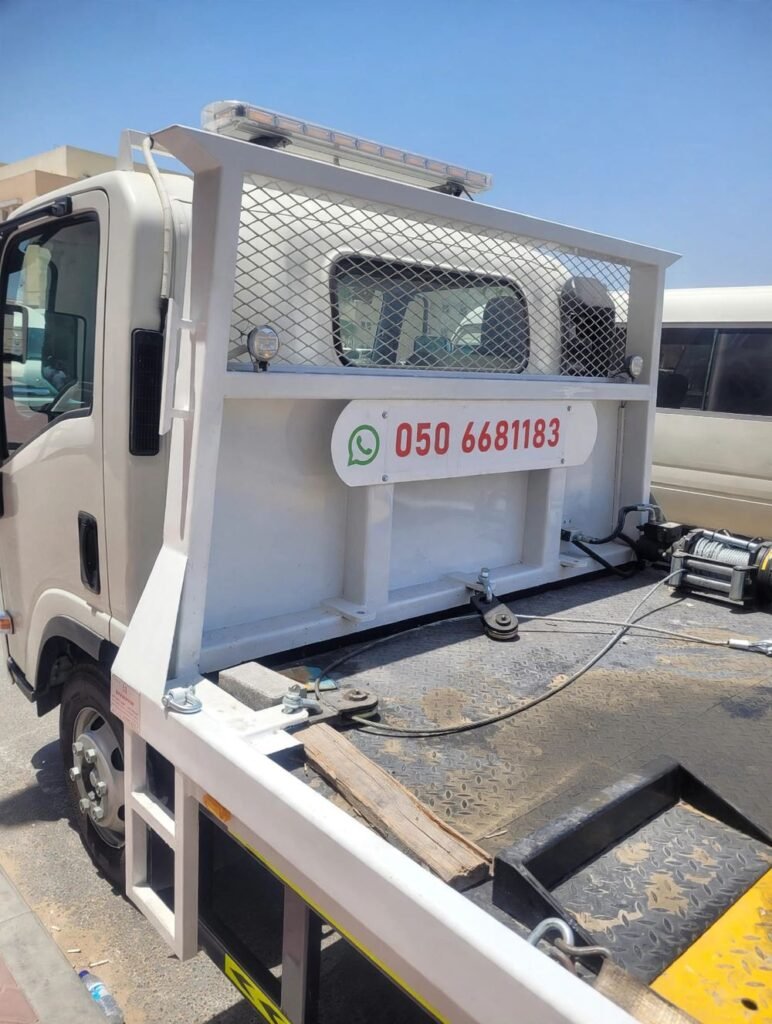
A flatbed truck has a long, flat platform that tilts down to the road, so your car is driven or winched up onto the bed and carried fully off the ground, with all four wheels off the road. It is the standard choice for most cars in Dubai, and the best choice when the car should not be dragged or rolled at all.
A flatbed is used when your car will not start, has a flat tyre, was in an accident, has locked steering or locked wheels, or is a low, lowered, luxury or sports car that needs careful loading. It is also the usual choice for SUVs and 4x4s, because the whole vehicle is lifted and secured on the bed. Our own recovery truck is a flatbed — the white Isuzu flatbed in our photos — and it is the truck sent for most recovery jobs.
2. Wheel-lift tow truck — a quick tow for cars that still roll
A wheel-lift truck lifts only the front or rear wheels off the road and tows the car on its other two wheels. It is a fast, simple setup for a car that still rolls freely and steers normally — for example, a car that broke down on a flat road and only needs a short move to a nearby garage.
It is not the right choice for every car. A car with damaged wheels, locked steering, a broken axle, or an all-wheel-drive system that should not be towed on two wheels needs a flatbed instead. If you are unsure which one your car needs, tell the dispatcher what happened and let them decide — sending the wrong truck costs more time than asking one extra question on the call.
3. Winch truck — for cars stuck in sand, a ditch, or off the road
A winch truck carries a strong cable and winch that pulls a car out of a place a truck cannot drive into — soft sand, a ditch, a basement ramp, or the side of a highway. The winch pulls the car slowly and steadily onto firm ground or straight onto the flatbed, instead of the car being forced or dragged.
In Dubai this is the truck for desert-edge breakdowns, cars bogged down in sand near a worksite or an unpaved area, and cars that have slipped off the road. If your car is stuck rather than simply broken down, say so on the call: a standard tow truck alone cannot finish the job, and the driver needs to arrive with winch equipment ready. Our winch-out recovery page explains this service in full.
4. Recovery pickup and van — smaller trucks for tight places
Not every job needs a large truck. A smaller recovery pickup — a flatbed built on a pickup chassis — can reach tight basement car parks, narrow community streets, and crowded mall parking areas where a large truck cannot turn or park. It carries one car, loaded the same flatbed way, and is often the fastest option inside a residential community.
Recovery vans play a different role: they carry tools and parts for on-the-spot help, such as a jump start, a tyre change, or fuel delivery, when the car does not need to be towed at all. If your car can be fixed where it stands, a van may be all you need — and the dispatcher will ask the right questions to work that out on the call.
Motorcycles need their own setup
A motorcycle is not loaded like a car. It is carried on a flatbed with a ramp, held upright and strapped down so it cannot tip or slide during the journey. A standard car tow setup without a ramp and proper straps can damage a bike. If you ride, tell the dispatcher it is a motorcycle — and its make and size — so the truck arrives with the ramp and straps ready. See our motorcycle towing page for the full service.
Which Tow Truck Will Come for Your Car?
The dispatcher decides from four things you tell them on the call:
- Your vehicle. A small car, a large SUV or 4×4, a lowered or sports car, and a motorcycle each need a different setup. Give the make and model, not just “a car”.
- What happened. A car that will not start is a different job from a car that was in an accident, will not roll, or is stuck in sand. Each one points to a different truck.
- Where the car is. A flat road, a basement car park, a busy highway, soft sand, and a ditch each need different equipment — and different access for the truck itself.
- Where it needs to go. Your destination — home, garage, or dealership — decides the route, and the route is part of the price confirmed on the call.
Give those four details clearly and the right truck is sent the first time. Guess at them, and the driver may arrive with the wrong setup and need to send for another truck — which is the one delay in recovery that is easy to avoid.
What Happens When the Tow Truck Arrives
Knowing what to expect at the roadside takes the stress out of the wait:
- The driver checks the car first. They look at the damage, the wheels, the steering, and where the car is sitting, and confirm how it will be loaded before anything moves.
- The car is loaded slowly. On a flatbed, the bed tilts down and the car is driven or winched up; on a wheel-lift, the lifted wheels are secured in the cradle. Nothing is rushed — a careful load is what keeps your car safe.
- The car is strapped down. Straps and chains hold the car in place so it cannot shift on the road. Loose or hanging parts are secured before the journey starts.
- You agree the destination. The driver confirms the drop-off address you gave on the call — garage, home, or dealership — before setting off.
- Drop-off and handover. At the destination the car is unloaded the same careful way, and the job is finished when the car is safely on the ground.
Take a photo of your car before it is loaded, and keep any paperwork or valuables with you rather than in the car. If you want to ride with the driver or follow behind, agree it when you book, so there is no confusion at the roadside.
Tow Truck Near Me: How to Get One Fast in Dubai
When you need a tow truck near you, speed comes from clear information, not from calling every number you find. Share your live location pin on WhatsApp, plus a road name or landmark — “near the Marina Mall exit on Sheikh Zayed Road” helps a driver far more than an area name alone. Say what happened in one line, and give your destination.
Recovery Dubai covers Dubai’s communities, highways, and business districts, 24 hours a day, 7 days a week, including nights, weekends, and public holidays. One call — +971 50 668 1183 — covers recovery, towing, and roadside help, and the dispatcher confirms your exact price before the truck is sent. If you are unsure which service you need, reach us through our contact page or call directly.
Frequently Asked Questions
What type of tow truck is best for my car?
For most cars, a flatbed — it carries the whole car off the road and suits cars that will not start, were in an accident, have locked wheels, or are low, luxury, or sports cars. A wheel-lift suits a car that still rolls freely and only needs a short tow. Tell the dispatcher your car and what happened, and they will send the right one.
How much does a tow truck cost in Dubai?
There is no single fixed price. It depends on your location, your vehicle, what happened to it, and where it needs to go. The exact price is confirmed with you on the call before the truck is dispatched, so you know the cost before committing. See our price guide for what affects the price.
Can a tow truck pull my car out of sand?
Yes — but it needs winch equipment. A standard tow alone cannot pull a car out of soft sand or a ditch. Tell the dispatcher the car is stuck, and the driver will arrive with a winch ready to pull it out safely before loading it.
Is a flatbed safer than a wheel-lift?
For most cars, yes — a flatbed keeps all four wheels off the road, so nothing is dragged or rolled. A wheel-lift is fine for a car that rolls and steers normally on a short tow, but it is not right for damaged wheels, locked steering, or cars that should not be towed on two wheels.
How do I book a tow truck near me in Dubai?
Call +971 50 668 1183 with your live location pin, your car’s make and model, what happened, and your destination. The dispatcher confirms the price on the call and sends the right truck for your job, 24/7 across Dubai.
Can a tow truck carry a motorcycle?
Yes, on a flatbed with a ramp — the bike is ridden or pushed up the ramp and strapped upright so it cannot tip during the journey. Tell the dispatcher it is a motorcycle when you call, so the truck arrives with the ramp and straps ready.
Our Recovery Services in Dubai
Need a Tow Truck? One Call Sends the Right One
Tell us where you are, what car you have, and what happened — we will confirm the price on the call and send the truck that fits your job, anywhere in Dubai, 24/7.
Call +971 50 668 1183 WhatsApp Us
24/7 across Dubai — or reach us through our contact page.